Dead Soil Does Not Feed Children
How a regenerative farm in Burkina Faso is proving that living soil is the most radical food policy of all
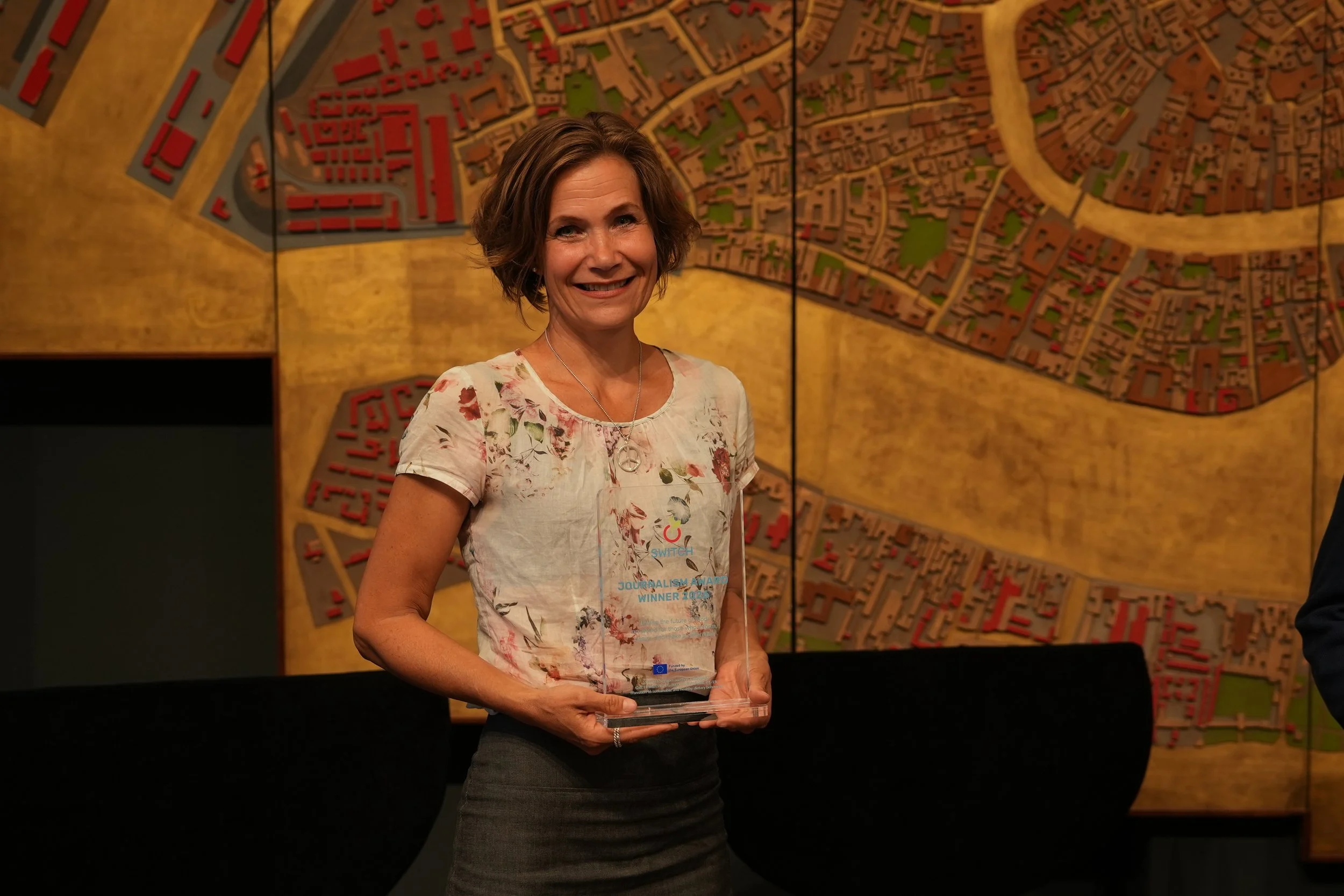
By Yennenga Progress / Published for the SWITCH Journalism Award 2026
In the Sahel region of Burkina Faso, one of the world's most food-insecure and climate-stressed areas, a small farm is doing something remarkable: healing its soil without a single gram of chemical fertiliser. Yennenga Progress Farm in Nakamtenga has more than doubled its vegetable and fruit output in a single year, moving from 1.5 tonnes to nearly 4 tonnes of produce, while simultaneously launching fish farming and a food-processing unit. But the farm's most significant achievement may not be agronomic. Local authorities are now exploring how the farm's regenerative methods can be embedded into every school in the region, transforming school gardens from decorative exercises into living classrooms of food sovereignty. This article argues that regenerative agriculture, far from being a northern luxury, is the most realistic long-term food strategy for Sub-Saharan Africa. It examines what patience, organic matter, and circular farming look like in practice, and why scaling this model through schools and local governance may be the most powerful food-systems intervention available in fragile states.
The Sahel does not forgive shortcuts
It is a Tuesday morning in Nakamtenga, a village in the plateau region of Burkina Faso. The harmattan has been blowing for days, coating everything in fine red dust. And yet, in the fields of Yennenga Progress Farm, rows of aubergine, tomato, paprika, moringa, and banana stand dense and green. The soil beneath them is dark and crumbly, not the baked laterite clay that stretches across most of the surrounding landscape. This soil is alive.
This distinction, between dead soil and living soil, is not poetry. It is the central fact of food security in the Sahel. Across West Africa, decades of chemical agriculture, one-sided cultivation without giving anything back to the soil to regenerate in combination with overgrazing have stripped topsoil of its microbial communities, its organic matter, and its capacity to retain water. As rainfall becomes more erratic and temperatures rise, the consequences are catastrophic. Burkina Faso already ranks among the most food-insecure nations in the world, with over 20 percent of its population in acute hunger. The military government that took power in 2022 has made agricultural self-sufficiency a rhetorical cornerstone of its agenda. But rhetoric does not grow food.
What grows food is soil. And Yennenga Progress Farm, is making soil. Slowly, deliberately, and without chemicals. The results, documented in the farm's 2025 annual report, are striking. Total production for the period February 2025 to January 2026 reached nearly 4 tonnes — more than double the 1.5 tonnes produced in 2024. No synthetic fertilisers, no pesticides. Just compost, cover crops, legumes, and time.
“The soil improvement we have been working on is now showing results. It means the earth itself is beginning to answer back.”
What regenerative farming actually looks like at 40°C
The vocabulary of regenerative agriculture was largely invented in temperate climates. Cover crops, no-till, composting, agroforestry, these concepts were refined in European and North American contexts. Critics have long argued that such methods are a luxury of wealthy farming systems, unsuited to the survival agriculture of the global South. Yennenga Progress Farm is a direct rebuttal of this argument.
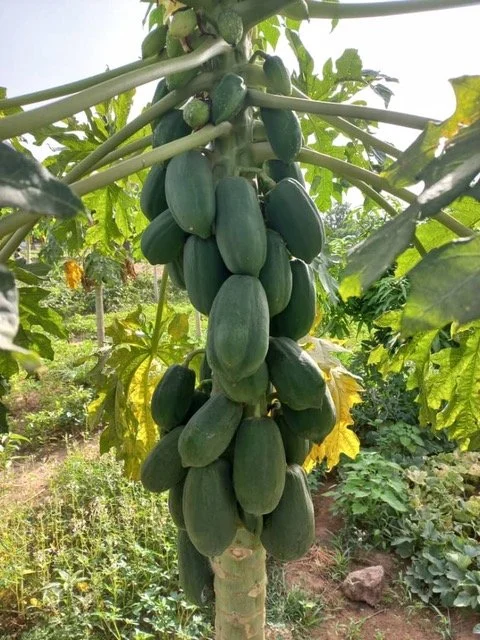
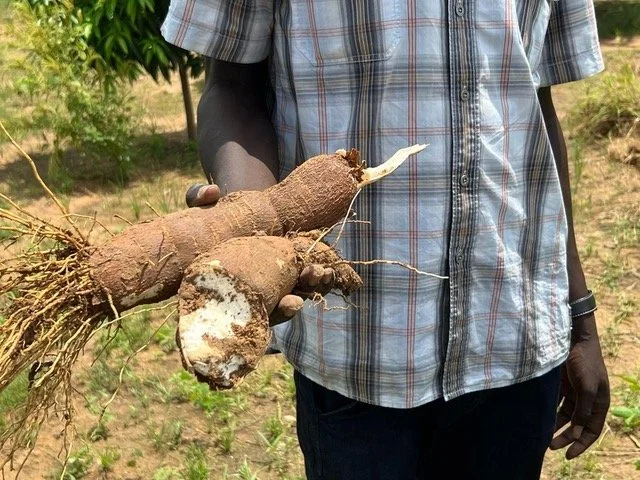
The farm's approach combines several interlocking systems. Organic waste from vegetables, animal husbandry, and fish farming is composted and returned to the fields. Nitrogen-fixing legumes such as haricot beans, sorghum interplanted with legumes are rotated through the growing cycle to rebuild the soil's nutrient base without purchased inputs. Moringa trees, both a nutritional powerhouse and a biomass source, are integrated throughout the growing areas. Papaya, planted in expanding orchards, provides multiple harvests per year while its fallen leaves add organic matter.
The water system, long a bottleneck, was fundamentally transformed in 2025. A third borehole, drilled in May, quadrupled water availability from 2 to 8 cubic metres per hour. Solar-powered pumping equipment was installed in September, making irrigation independent of the grid. But the most elegant innovation is aquaponic: the farm's new fish- farming unit with four tanks of 5,000 litres each, stocked with 800 tilapia fingerlings, generates nutrient-rich wastewater that is piped directly to irrigate the vegetable beds. Fish feed soil and soil feeds people.
The projected output of the fish unit alone, approximately 3 tonnes of tilapia per year once fully operational, illustrates the multiplier effect of circular farming. In a country where animal protein is scarce and expensive, this is not a marginal addition. It is a structural change.
Patience as a political act
There is a reason that chemical agriculture spread so rapidly across Sub-Saharan Africa in the 1960s and 1970s: it worked fast. Green Revolution inputs could double or triple yields in a single season. The long-term costs such as soil degradation, water contamination, loss of crop diversity, farmer debt, dependence on imported inputs, were deferred. They are now being paid.
Regenerative agriculture requires the opposite of impatience. The annual report is candid about this: lower short-term yields are the price of long-term soil health. In a context where farmers are living season to season, where children may go hungry between harvests, where a failed crop can mean catastrophy, asking people to accept lower yields now for better soil later is not a simple ask. It is a political and ethical commitment.
What Yennenga Progress has understood is that this commitment must be collective, not individual. No single smallholder farmer can absorb the risk of transitioning to regenerative
methods alone. But an institution such as a farm, a school, a cooperative, can model the transition while the community observes, learns, and adapts at lower risk. The farm in Nakamtenga is not primarily a production unit. It is a demonstration site. Its most important output is not the 540 kg of sorghum or the 424 kg of tomatoes. It is the knowledge it generates and the confidence it builds.
“Living soil is not the romantic ambition of idealists. It is the only realistic long-term food strategy available to the Sahel.”
The school garden as a food system classroom
Here is where the story becomes genuinely scalable and where the most important innovation of Yennenga Progress may lie.
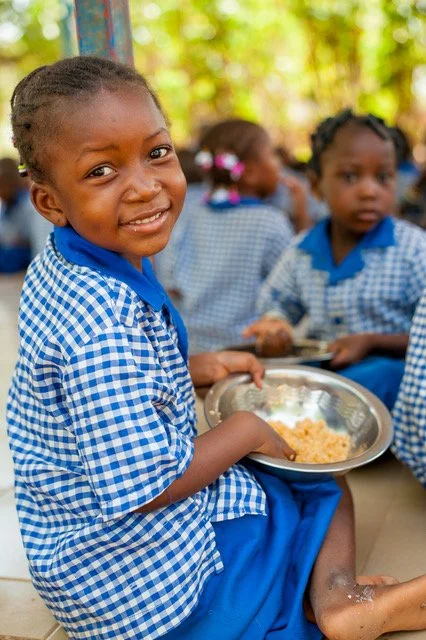
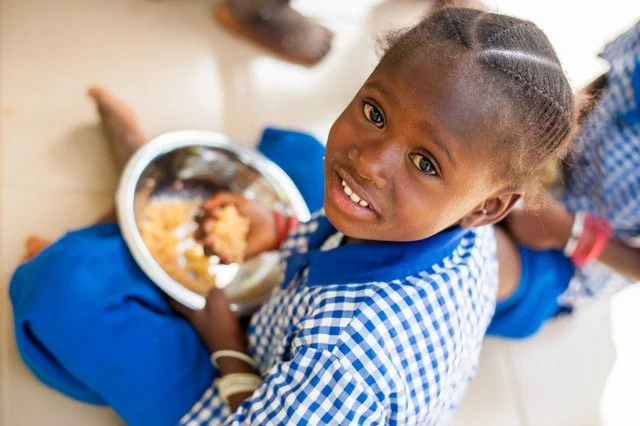
Across Burkina Faso, as across much of Sub-Saharan Africa, schools have gardens. In the development literature, school gardens are often celebrated as nutrition interventions, children grow vegetables, eat them, learn about food. In practice, they frequently amount to little more than planting seeds and watering them, supervised by teachers with no agricultural training and no clear pedagogical framework. The vegetables are often eaten by insects. The soil is never improved. The lesson learned, implicitly, is that growing food is difficult and unreliable.
Yennenga Progress is in active dialogue with local education and agricultural authorities about a fundamentally different model. In this model, the farm in Nakamtenga becomes a training and demonstration hub. Teachers and school garden coordinators learn regenerative practices with composting, companion planting, mulching, seed saving and take them back to their schools. School gardens become not decoration but living science laboratories, where children learn chemistry through compost, biology through legume root nodules, mathematics through crop yields, and food culture through preparing what they grow.
The local authorities' openness to using the farm's communication and methods across all schools in the region is significant. It means that what has been learned on a few hectares in Nakamtenga could, within a few years, reach thousands of children simultaneously. Not through a top-down curriculum decree, but through living, edible, hands-on evidence.
This is food education as food system transformation. When a child learns that dead soil grows nothing and then watches a teacher return compost to a raised bed and sees something grow that child carries a different understanding of food and farming for life. Multiply this by an entire school system, and you begin to approach the kind of cultural shift that makes regenerative agriculture not a niche practice but a default assumption.
Processing, value chains, and economic sovereignty
A farm that produces food is important. A farm that processes food, builds local value chains, and keeps economic value within the community is transformative.
In 2025, the Nakamtenga farm produced 1,345 bottles of fruit juice, as well as 272 jars of tomato paste and 53 jars of jam made from mango, papaya, and guava. A dedicated processing facility was completed in October. Demand exceeds current production capacity.
This matters beyond the numbers. In Sub-Saharan Africa, the majority of food value is captured outside farming communities, by traders, processors, retailers, often located in distant cities or imported from abroad. When a farm produces and processes its own products, bottles its own juice, jars its own paste, it captures value that would otherwise leak away. Workers earn more. The local economy becomes more resilient. The farm becomes more financially sustainable.
The processing unit also creates a new category of female employment. The responsibility for fruit and vegetable processing at the Nakamtenga farm has been explicitly assigned as a new function, a small but deliberate step toward gender-inclusive agricultural labour in a context where women do most of the subsistence farming but are often excluded from the paid and processed end of the value chain.
Fragile states, strong roots
It would be dishonest to write about Burkina Faso in 2025 without acknowledging the context in which this farm operates. The country is governed by a military president that has curtailed civil freedoms, expelled international partners, and suspended the transition to civilian rule. Jihadist violence continues across the north and east, displacing millions. Access to some regions is impossible for NGOs. Aid workers have been expelled.
And yet the farm continues. Local relationships with municipal authorities have remained functional. Daily operations have not been disrupted. The farm workers and their manager, Pamoussa Sawadogo, show up every Monday for the weekly team meeting that has become a cornerstone of the farm's learning culture. Pigs are healthy. Tilapia fingerlings are swimming. The soil is improving.
This resilience is not incidental. It is a product of the farm's model: deeply local, deeply practical, not dependent on external supply chains or imported inputs. When the broader political environment deteriorates, a regenerative farm that produces its own compost, saves its own seeds, and trains its own workers has something that chemically dependent agriculture does not: autonomy.
This is perhaps the most underappreciated argument for regenerative agriculture in fragile states. It is not only an environmental argument, or a nutritional argument, or an economic argument. It is a sovereignty argument. Soil that is alive does not need to be purchased each season from a multinational supplier. Knowledge that is embodied in workers and embedded in a community does not disappear when an NGO withdraws. A circular food system is, by definition, less vulnerable to the supply chain disruptions, import dependencies, and price shocks that make hunger catastrophic in conflict contexts.
“A farm that feeds itself is a farm that can keep feeding others, regardless of what happens beyond its fence.”
What scaling actually means
The word 'scale' is used carelessly in development discourse. It often implies replication, taking what works in one place and reproducing it identically everywhere. Regenerative agriculture does not scale that way. It scales through knowledge, through demonstration, through adaptation.
What can be scaled from Nakamtenga is not the specific mix of crops, or the particular fish tanks, or the exact composting protocol. What can be scaled is the principle: that soil is a living system; that what you put into it determines what comes out; that circular systems are more resilient than linear ones; that workers who understand what they are doing and why are more productive than workers who follow instructions without comprehension.
The weekly Monday training meetings that began in September 2025, already showing measurable increases in motivation, knowledge, and engagement among farm workers, are themselves a model for how knowledge spreads. Not through a training manual. Not through a one-day workshop. Through regular, embodied, practical learning embedded in the rhythm of work.
Local authorities who embed this model in schools are making a bet not on a technology but on a pedagogy. They are betting that children who grow food regeneratively will become adults who farm differently, who make different consumer choices, who demand different food policies. That bet is likely the highest-return education investment available in the region.
The most important four tonnes in the Sahel
Nearly 4,000 kilograms of vegetables, fruit, and grain. Over a thousand bottles of juice. Three hundred jars of preserved food. Thirty-three pigs. Eight hundred tilapia. A processing facility. A solar pump. A living soil.
These are the outputs of one farm, in one village, over one year. They are also proof of concept for a food system that does not require chemical inputs, does not degrade its own productive base, and does not need to import its resilience.
The children in Burkina Faso's schools do not need to be told that food is important. They know. What they need to be shown, through school gardens that are genuinely alive, through teachers who know why the compost is turning dark, through kitchens that cook what grows nearby, is that food sovereignty is possible. That living soil is achievable. That patience, in a world that rewards shortcuts, is a form of courage.
Yennenga Progress Farm in Nakamtenga is not the answer to the Sahel's food crisis. No single farm is. But it is an argument, made in soil and seeds and tilapia fingerlings and Monday morning meetings, that the future of food in West Africa runs through the earth beneath our feet and that the earth, given time and care and the right knowledge, will respond.